

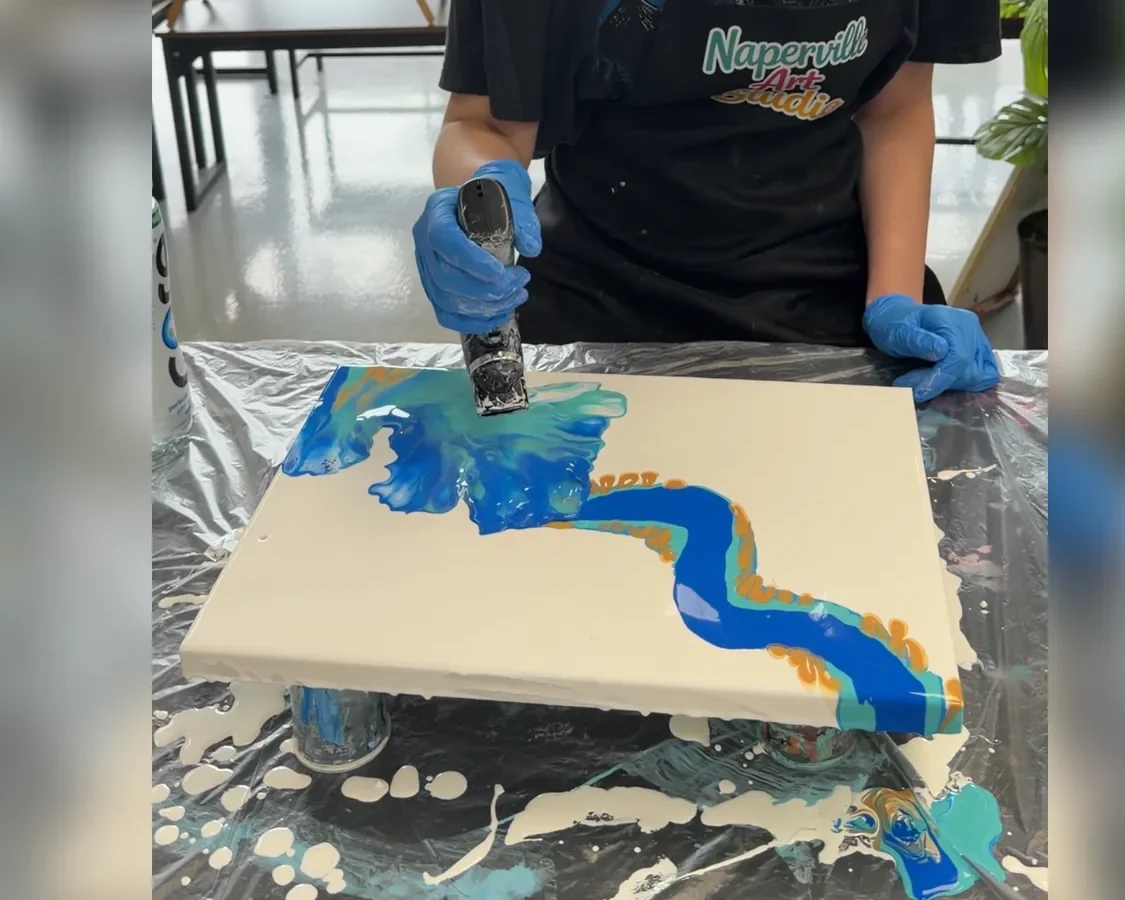
Fluid art is painting without a brush. You thin the paint, pour it onto a surface, and then move it with tilt, air or gravity until the colors marble into each other. The pattern that lands is the finished piece, and it is different every single time.
That is the short answer. Here is what it actually looks like when you try it, and what to expect if you have never touched paint since school.
What is fluid art?
Fluid art, also called pour painting or acrylic pouring, is a technique where paint is thinned to a pourable consistency and applied by pouring rather than brushing. Once the paint is on the surface, you move it: tilting the canvas so the colors run, spinning it, or pushing the paint with air from a blow dryer or heat gun. The colors blend at their edges and settle into cells, ribbons and marbled veins.
Nothing about it is precise, which is the point. There is no drawing, no outline to stay inside, and no correct result to compare yours against.
How is it different from a paint and sip class?
In a paint and sip class, an instructor paints a picture at the front and you copy it. Everyone leaves with a version of the same painting, and how good yours looks depends on how steady your hand is.
Fluid art has no template to copy. You choose your colors and the paint does the rest, so a first-timer and someone who paints every weekend get equally interesting results. That is why it works for mixed groups where the skill levels are all over the place.
Do you need any experience?
No. Most of our guests at Naperville Art Studio walk in saying they are not artistic. Our team guides you through each step: how much paint, what order to pour, when to stop moving it. The technique takes about two minutes to learn and the rest of the session is just doing it.
Ages 4 and up can pour. Younger children work alongside a parent.
What can you make with fluid art?
Canvas is where most people start, but fluid art works on almost any surface. In our studio you can pour onto:
- Canvas, from small to statement size
- Resin tumblers and insulated water bottles
- Charcuterie boards and wooden serving trays
- Sculptures: bears, bunnies, cats and figures
- Vases, lazy susans, coasters and jewelry trays
- Denim jackets and trucker hats
- Resin ocean art, layered to look like a real shoreline
There are 25 projects in total, and you pick yours when you arrive rather than when you book.
How long does a fluid art class take?
About 60 minutes in the studio. Arrive 10 minutes early to walk the shelves and choose your project without rushing.
The piece itself does not go home with you that day. It has to cure, and resin pieces have to be sealed and finished properly. That takes about 10 days, after which you collect it or we ship it to you.
What does it cost?
Booking is $25 per person, and that $25 is the first $25 of whatever you make rather than a separate class fee. Projects run from $25 for a patch trucker hat to $105 for a rechargeable lamp, with canvases at $35 for kids and $45 for adults. One price covers the session, every material, guidance and the professional finish.
Why the results are unpredictable
Thinned paint behaves like a liquid, because it is one. Denser pigments sink, lighter ones rise, and where two colors meet they push against each other and form cells. Tilt the surface and gravity drags everything into ribbons. Hit it with air and the paint spreads outward in a bloom.
You are steering the process, not controlling it. Two people pouring identical colors onto identical canvases will not produce matching pieces, and that is what people find satisfying about it.
Common questions
Is fluid art messy?
Less than you would think. Aprons and gloves are provided and the pouring happens over trays. Short sleeves make it easier. We handle the cleanup.
Can kids do fluid art?
Yes, from age 4. It is one of the few creative activities where a child and an adult can work side by side and both be pleased with the result.
Does fluid art use resin?
Not always. Canvas pours are finished with a matte coat, with a high-gloss resin upgrade available. Boards, trays, tumblers and ocean art are all finished with resin.
Where can I try fluid art near Naperville?
We are at 115 E Ogden Ave, Suite 121 in Naperville, a few minutes from downtown. Sessions run Wednesday through Monday, and weekends usually fill a week or two ahead.
Where can I take a fluid art class near Naperville?
At 115 E Ogden Ave, Suite 121 in Naperville, a few minutes from downtown. Guests travel to us from across the towns around Naperville including Aurora, Wheaton, Lisle, Downers Grove, Bolingbrook, Plainfield and Warrenville. Sessions run Wednesday through Monday.
Ready to try it? Have a look at our fluid art classes and book a spot. You choose your project once you are here.